
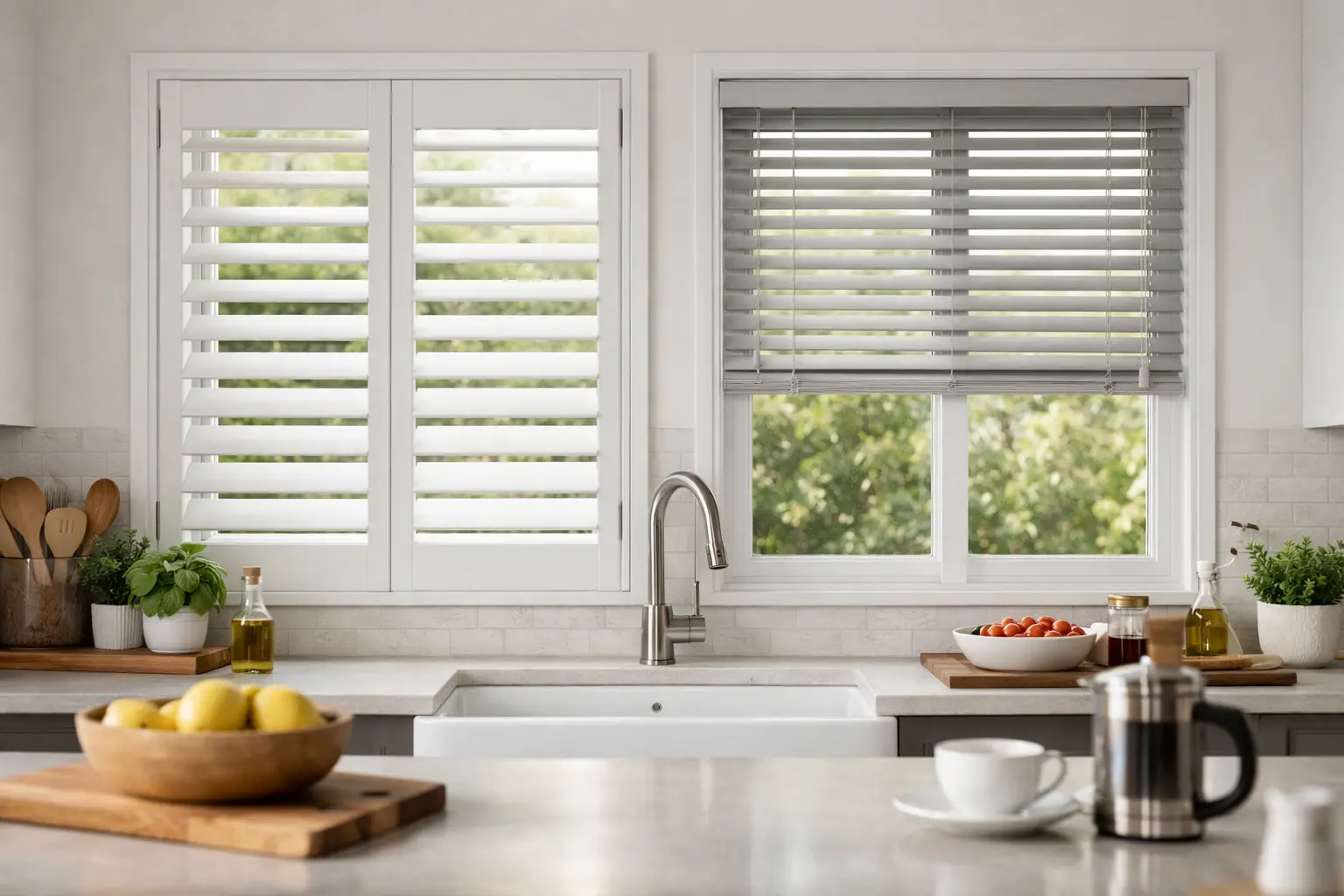
Steam from the kettle, late-afternoon sun across the worktop, neighbours closer than you would like – the kitchen asks more of a window covering than almost any other room. If you are weighing up kitchen shutters or blinds, the right choice comes down to how you use the space, how much moisture it deals with, and the finish you want every day.
A kitchen is practical by nature, but it is also one of the most visible rooms in the home. It needs privacy without losing daylight, a finish that can cope with heat and condensation, and a look that feels considered rather than like an afterthought. That is why the shutters versus blinds question is not simply about appearance. It is about performance, longevity and how tailored you want the final result to feel.
Kitchen shutters or blinds: the main difference
The clearest difference is structure. Shutters are fitted frames with solid panels and adjustable louvres, made to sit neatly within or around the window. Blinds are softer or lighter in appearance, with fabric, slats or vanes that raise, lower or tilt depending on the style.
That structural difference changes the whole feel of the room. Shutters tend to look more architectural. They give the window a finished, built-in quality that suits both modern kitchens and more traditional spaces. Blinds are often a little more understated and can be the better option when you want a simpler line or a softer decorative touch.
From a practical point of view, shutters are generally stronger on durability and long-term visual impact. Blinds offer more variety in texture, colour and operating style. Neither is automatically better. The better option is the one that suits your kitchen window, your daily routine and the conditions in the room.
Why kitchens need more careful product choice
A bedroom blind can prioritise softness and blackout. A living room shutter can lean heavily on style. Kitchens are less forgiving. Moisture, grease particles, temperature changes and frequent cleaning all affect what will work well over time.
If your window sits near the sink or hob, material choice matters more than trend. A product that looks beautiful on day one but warps, stains or becomes awkward to clean will not stay appealing for long. This is where made-to-measure advice makes a real difference, because the best solution often depends on details that are easy to overlook – window depth, sill space, splash exposure and how often the room steams up.
When shutters are the stronger choice
Shutters are often chosen for kitchens because they combine clean lines with day-to-day practicality. Their fitted design means there is less movement, less fabric to absorb cooking odours, and a crisp finish that feels part of the room rather than simply added to it.
Plantation-style shutters are especially effective if you want precise light control. You can tilt the louvres to soften glare while still keeping the room bright, or close them for privacy without making the space feel shut in. In kitchens that face the street or overlook neighbouring properties, that flexibility is a major advantage.
Waterproof composite shutters are particularly well suited to kitchens with higher humidity. They cope well with condensation and are easy to wipe clean, which makes them a dependable choice near sinks and busy family zones. If your priority is longevity with minimal fuss, this is often where shutters pull ahead.
Shutters also suit homeowners who want a premium, cohesive finish. They frame the window beautifully and can add a sense of order to the room, especially in open-plan kitchen-diners where visual consistency matters.
When blinds make more sense
Blinds can be the right answer when you want a lighter look, a lower profile, or a style that works around specific window shapes and layouts. They are also useful where there is less depth for a shutter frame or where the window is opened frequently in a way that may affect panel design.
Roller blinds are a popular kitchen choice because they are neat, simple and easy to operate. With the right fabric, they can offer privacy while still letting in light, and they sit compactly when raised. Faux wood Venetian blinds are another practical contender, giving you the look of painted slats with better resistance to moisture than natural timber in more demanding areas.
Roman blinds can look elegant in a kitchen, especially in calmer, less moisture-heavy spaces, but they are not always the most practical beside cooking and washing zones. Fabric requires more care, and in a hard-working kitchen that can be a compromise too far. Vertical blinds are usually less common in domestic kitchens unless the window is large or part of a glazed door arrangement.
Style, maintenance and day-to-day living
Design matters, but so does how a product behaves on an ordinary Tuesday morning. A kitchen window treatment should be easy to live with.
Shutters are straightforward to maintain. A quick dust and occasional wipe is often enough, particularly with waterproof materials. Because there are no hanging fabrics, they tend to keep their shape and finish well. For many households, that ease of care is one of their strongest selling points.
Blinds vary more. A faux wood Venetian blind can be practical and wipeable, while a fabric blind may need more regular attention. Slatted blinds can collect dust and grease over time, especially if they are close to the hob, so cleaning routine should not be ignored when choosing style.
There is also the matter of visual weight. Shutters give a room substance. They can make even a simple kitchen feel more tailored and expensive. Blinds can either blend in quietly or introduce softness and colour, depending on the design. If your kitchen already has a lot of cabinetry detail, a simpler blind may be enough. If the room needs a stronger finishing feature, shutters may do more for the overall look.
Light and privacy in real kitchens
Kitchen light is rarely constant. Morning sun can feel lovely until it lands directly on a breakfast bar. Evening lighting can expose the room more than expected, particularly in terraced or semi-detached homes.
Shutters handle these shifts extremely well. Café-style shutters, which cover only the lower portion of the window, are useful where privacy is needed but you still want plenty of daylight. Full-height shutters offer a more complete and balanced appearance, while tier-on-tier designs give separate top and bottom panel control. That flexibility is difficult to match.
Blinds can still perform very well here, especially Venetian and roller styles. Venetian blinds allow for tilt control, while rollers offer a clean open-or-closed solution. The trade-off is subtlety. Shutters often allow more nuanced adjustment through the day, whereas some blind styles are a little more binary in use.
Cost versus long-term value
Budget always plays a role, and it is sensible to be clear-eyed about it. Blinds are often more affordable at the entry point, depending on the style and fabric. If you need a practical upgrade and want to keep costs tighter, there are excellent blind options available.
Shutters usually involve a higher initial investment because they are a more substantial fitted product. However, many homeowners see them as a long-term improvement rather than a quick furnishing choice. They tend to last well, they elevate the appearance of the room, and they can reduce the cycle of replacing tired off-the-shelf solutions.
So the question is not only what costs less today. It is also what will still look and perform well in five or ten years.
Should you choose kitchen shutters or blinds?
If your priority is a polished, bespoke finish with excellent moisture resistance, easy maintenance and strong light control, shutters are often the better fit. They work particularly well in kitchens where the window is a visible feature and where durability matters just as much as style.
If you want flexibility in texture or colour, need a more budget-conscious option, or are working with a window better suited to a lighter treatment, blinds can be exactly the right choice. The best versions are still made-to-measure, carefully selected for the conditions in the room, and professionally fitted for a clean result.
For many homeowners, the real decision comes down to whether the kitchen window should quietly support the room or actively enhance it. Shutters tend to do the latter. Blinds can do the former beautifully, provided the material and fit are right.
At Sunshades Shutters, that is where tailored guidance matters. A well-chosen window treatment should not just look good in a brochure. It should suit your kitchen, your habits and the way you want the room to feel every day.
The best kitchen window covering is the one that still looks right after steam, sunlight, school runs and Sunday cooking – and still makes the room feel finished when everything else is in motion.