
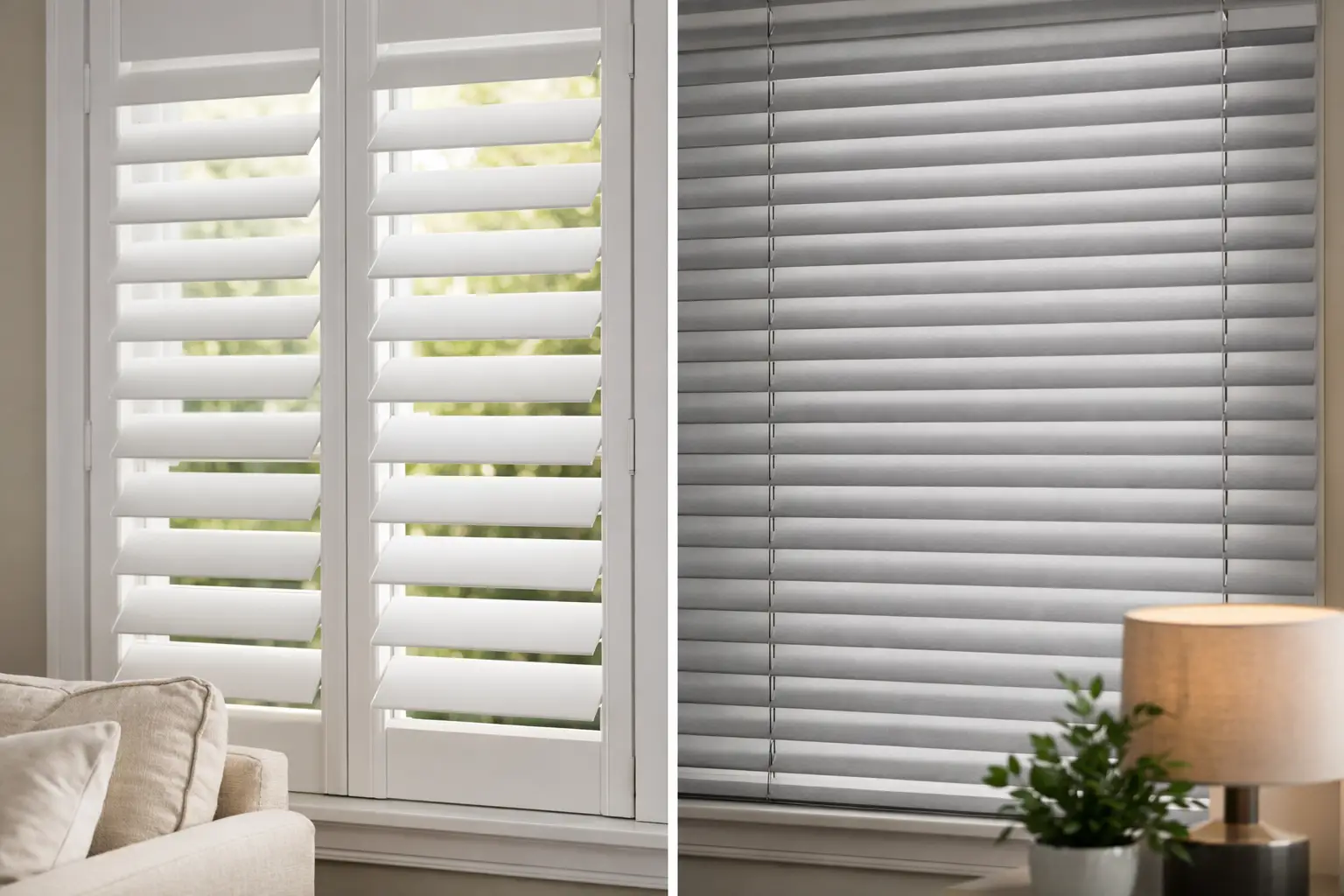
Street-facing windows tend to settle the question quickly. If you have ever adjusted a blind slat by a few millimetres to stop passers-by seeing in, only to lose half the daylight as well, you already know that shutters vs blinds for privacy is not a simple style choice. It is about how you want your home to feel, how each room is used, and how precise you need that balance between natural light and screening to be.
For most homeowners, both shutters and blinds can improve privacy far more effectively than leaving windows bare. The real difference lies in how they manage sightlines, how neatly they fit the window, and whether you want your window treatment to read as a practical addition or a more permanent part of the room. That is where the decision becomes more nuanced.
Shutters vs blinds for privacy: the core difference
Shutters are fixed, framed window coverings with panels and louvres that sit close to the window itself. Because they are made to measure and installed directly to the recess or frame, they tend to create a more complete, tailored barrier between your interior and the outside world. You can tilt the louvres to maintain privacy while still allowing in a good level of daylight, which is one of their strongest advantages.
Blinds work differently. Whether you choose roller, Roman, Venetian, vertical or sheer blinds, they are generally softer or lighter in profile and operate by raising, lowering, or tilting depending on the style. They can be highly effective for privacy, but the degree of control varies significantly by blind type. A blackout roller blind offers excellent screening when down, for example, but gives you far less flexibility than shutters if you want privacy without fully closing off the room.
So if the question is simply which usually provides the more refined and controlled privacy solution, shutters often come out ahead. If the question is which offers privacy in a wider range of price points and styles, blinds deserve serious consideration.
Where shutters tend to perform better
Shutters are particularly strong in rooms where privacy is needed throughout the day rather than just after dark. Ground-floor living rooms, front bays, home offices and street-facing dining spaces are good examples. In these settings, the ability to angle louvres means you can reduce direct visibility from outside without making the room feel closed in.
That matters more than many people expect. Full privacy is easy if you are happy to block the window completely. The challenge is preserving brightness and a sense of openness at the same time. Plantation shutters do this especially well because the louvres give you incremental control rather than a simple open-or-shut result.
There is also the matter of fit. A bespoke shutter installation sits neatly against the window, which reduces awkward gaps and gives a cleaner finish. From both inside and outside the home, that precision creates a more polished appearance. For homeowners investing in a well-finished interior, shutters often feel less like a temporary furnishing and more like part of the architecture.
Bathrooms and kitchens are another area where shutters can be a practical privacy solution. Waterproof composite options cope well with moisture, steam and daily use, while still delivering the same smart, structured look. In these rooms, privacy and durability usually need to go hand in hand.
The trade-off with shutters
The main trade-off is cost. Shutters are a premium product and, because they are custom made and professionally fitted, they usually represent a bigger upfront investment than blinds. They are also more visually defined. That is a positive for many homeowners, but if you want a softer textile finish or a very minimal window dressing, shutters may not suit every room.
When blinds are the better privacy choice
Blinds can be excellent for privacy when chosen with the room in mind. The key is not to think of blinds as one category. A roller blind behaves very differently from a Venetian blind, and a Roman blind creates a different effect again.
For bedrooms, blackout blinds are often the most practical answer if your priority is total screening and light reduction. They are straightforward, effective and available in a wide range of fabrics and finishes. If privacy is mainly needed in the evening and at night, they can do the job very well.
Venetian blinds are the closest blind equivalent to shutters in privacy terms because their slats can be tilted. Wooden and faux wood Venetian blinds are especially popular where homeowners want clean lines and directional light control without moving to a full shutter installation. They can offer a good balance between appearance, privacy and budget.
Roman blinds bring softness and warmth, which suits bedrooms, snug rooms and more decorative living spaces. Privacy is good when they are lowered, but unlike shutters or Venetians, they do not allow for that same fine-tuned adjustment during the day. Vertical blinds are practical on larger windows and patio doors, while sheer blinds can soften views and reduce visibility without darkening the room too heavily.
The trade-off with blinds
Blinds offer more variety in look and price, but some styles are less precise when privacy is the priority. Depending on the product and the installation, there can be light gaps at the sides or less control over viewing angles. Off-the-shelf blinds are particularly prone to this. A made-to-measure blind improves the result considerably, but the style you choose still affects how much flexibility you get.
Privacy in daytime vs privacy at night
This is where many buying decisions go astray. Daytime privacy and night-time privacy are not quite the same problem.
During the day, shutters excel because tilted louvres can interrupt direct sight into the room while still admitting daylight. Venetian blinds can also do this well, though usually with a lighter, less architectural feel. Roller and Roman blinds are less flexible here because they tend to be either up or down.
At night, when lights are on inside the home, privacy depends far more on complete coverage. Closed shutters provide strong protection, but so do properly fitted blackout or lined blinds. If your main concern is evening privacy in bedrooms or bathrooms, blinds may be perfectly sufficient. If your concern is all-day privacy on a busy road, shutters usually offer the more comfortable everyday solution.
Style matters more than people think
Privacy may be the starting point, but appearance usually shapes the final choice. Window treatments sit at eye level and have a major impact on how finished a room feels.
Shutters bring structure, symmetry and a tailored look that suits period homes, bay windows and contemporary interiors alike. They add visual value because they look purposeful and permanent. In many homes, they help a room feel more considered, especially when the windows are a prominent feature.
Blinds are more varied. They can be sleek and understated, soft and decorative, or practical and discreet. That flexibility is useful if you want each room to have its own character. A calm linen-look Roman blind in a bedroom creates a very different mood from crisp white shutters in a front lounge. Neither is inherently better. It depends on whether you want consistency throughout the house or a more room-by-room approach.
Which option suits each room?
For front-facing reception rooms and ground-floor spaces, shutters are often the strongest choice because they give privacy without sacrificing a bright, welcoming feel. In bedrooms, blinds can be especially effective where blackout performance matters most. In bathrooms and kitchens, moisture-resistant shutters or faux wood blinds are usually the most practical options.
For large glazed doors or expansive modern windows, vertical or roller blinds may be easier to operate and more cost-effective. For bay windows, shaped windows or homes where kerb appeal matters, shutters often justify the investment because of the fit and finish they deliver.
This is where tailored advice makes a real difference. The best result rarely comes from choosing shutters for every room or blinds for every room. It comes from matching the product to the way each space is used.
So, shutters or blinds?
If you want the most refined answer to shutters vs blinds for privacy, shutters generally offer better daytime control, a neater fit and a more elevated finish. They are particularly strong in street-facing rooms where maintaining both privacy and natural light matters every day.
Blinds remain an excellent choice where budget, softness of style, blackout performance or simpler operation take priority. In the right fabric or slat design, they can deliver exactly what a room needs without overcomplicating the scheme.
At Sunshades Shutters, this is often the point where homeowners realise the right answer is not one product across the whole house, but a made-to-measure combination that works room by room. If privacy is high on your list, the smartest choice is the one that fits your windows properly, suits the way you live, and still looks right every time you walk into the room.
A well-dressed window should do more than block a view from outside. It should make the room feel calmer, more comfortable and unmistakably finished.