
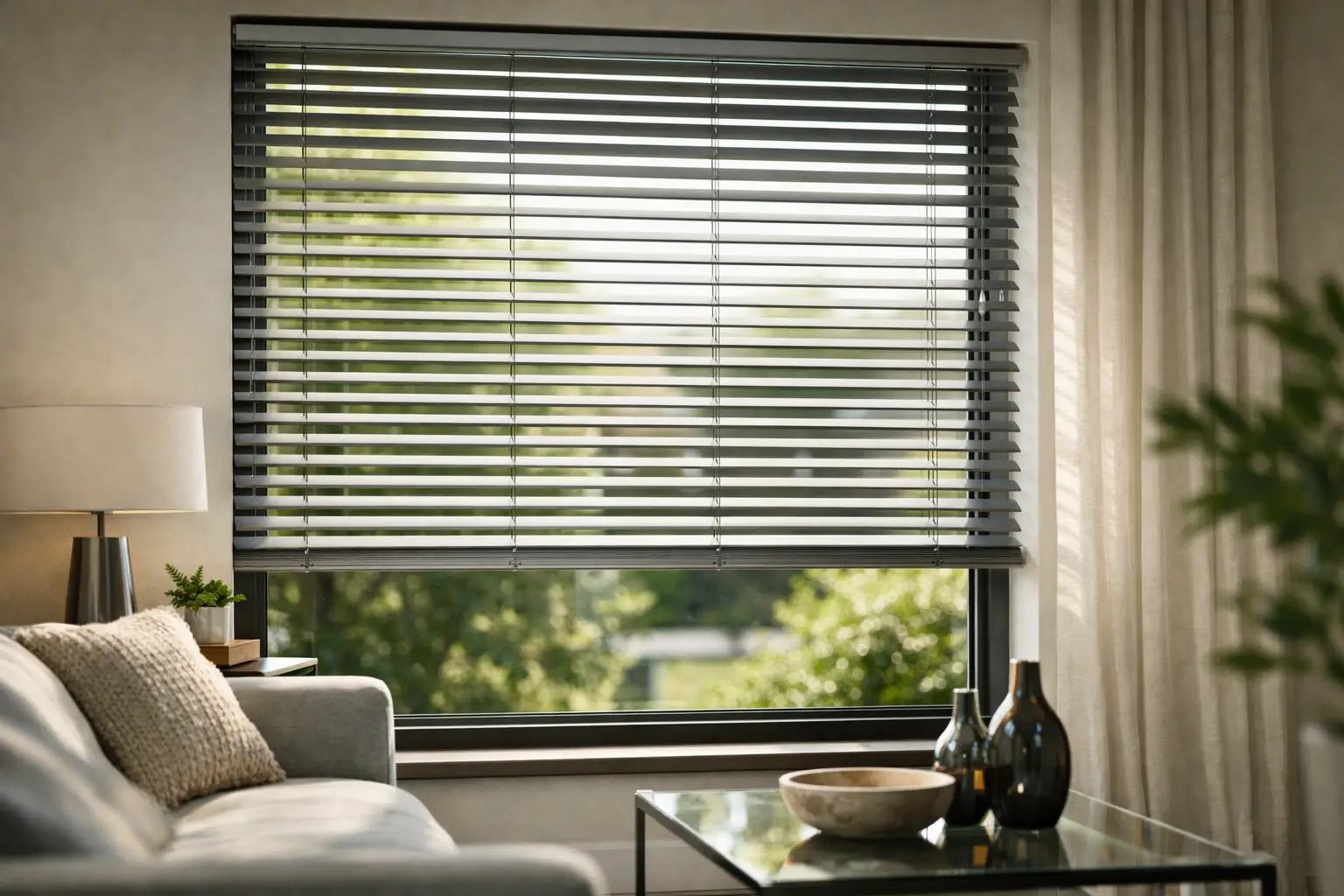
A bright south-facing bay window can make a room feel wonderful at breakfast and uncomfortably exposed by mid-afternoon. Venetian blinds give you a more precise answer than simply opening or closing a covering: tilt the slats for softened daylight, raise them for an uninterrupted view, or close them for privacy when the room needs it. For homeowners who want a clean, considered finish without sacrificing everyday practicality, they remain one of the most versatile choices.
Their appeal lies in control. The horizontal slats can be adjusted in small increments, changing the mood of a space while helping to manage glare, overlooking and solar heat. When made to measure and professionally fitted, a Venetian blind sits neatly within the window area and looks purposeful rather than temporary.
Why Venetian Blinds Work So Well
Unlike a fabric blind that is generally either up or down, a Venetian blind lets you direct light. Tilt the slats upwards to bring daylight towards the ceiling, reducing glare on screens while keeping the room bright. Tilt them downwards for more privacy from neighbouring properties or passers-by. This makes them especially useful in reception rooms, home offices, street-facing bedrooms and kitchens.
The look is equally adaptable. Fine metal slats lend themselves to a contemporary kitchen, utility room or minimalist extension. Wooden Venetian blinds introduce warmth and texture, working beautifully with timber flooring, painted cabinetry and period details. Faux wood offers a similarly substantial appearance with better resistance to moisture, making it a sensible option where humidity is part of daily life.
There is, however, a trade-off. Venetian blinds have more individual surfaces than a roller blind, so they need occasional dusting. They are also designed for flexible light control rather than complete darkness. In a bedroom where true blackout is the priority, a blackout blind or curtain may be the stronger choice, or it can be paired with a Venetian blind for added softness and privacy.
Choosing the Right Venetian Blind Material
The best material depends on the room, the window and the finish you want to achieve. It is worth considering how the blind will be used every day, rather than choosing on colour alone.
Wooden Venetian Blinds
Real wood brings natural grain and a reassuringly premium feel. It is often the right choice for living rooms, dining rooms, studies and bedrooms where you want the window to become part of the interior scheme. Wood works particularly well in homes with traditional architecture, but it can look equally at home in a modern space when finished in a clean white, soft grey or deep painted tone.
Because wood is a natural material, it is best kept away from persistently damp conditions. A well-ventilated bedroom is ideal; a steamy bathroom is not. Wider slats can create a more architectural look and show off the grain, while narrower slats feel lighter and can suit smaller windows.
Faux Wood Venetian Blinds
Faux wood is a practical alternative for busy homes. It has the substantial appearance of painted timber, is easy to wipe clean and copes better with changing temperatures and humidity. That makes it a strong candidate for kitchens, bathrooms and utility rooms, as well as family spaces where fingerprints and splashes are inevitable.
The material is usually heavier than real wood, which matters on very wide windows. Accurate measuring, suitable brackets and professional installation are particularly valuable here, ensuring the blind operates smoothly and stays secure over time.
Aluminium Venetian Blinds
Aluminium Venetian blinds are slim, durable and available in a broad range of colours and finishes. Their crisp profile suits contemporary interiors, compact rooms and practical areas where easy cleaning matters. They can also be an excellent solution for home offices, where controlled daylight helps reduce reflections on monitors.
Metal slats do not offer the same warmth as wood, but that is often the point. A brushed, matt or neutral finish can make the window feel clean and deliberately understated. For rooms with strong sunlight, the reflective qualities of aluminium can also help moderate the intensity of direct light.
Getting Light Control Right
The direction of the slats makes a noticeable difference. With the slats angled upwards, light is encouraged towards the ceiling and deeper into the room. This can preserve natural brightness while limiting harsh glare. Angling them down gives a more private feel and reduces sightlines from outside, which is useful in ground-floor rooms and properties that face closely positioned neighbours.
For windows that receive strong afternoon sun, the ability to make small adjustments throughout the day is a real benefit. You are not forced to choose between a darkened room and full exposure. In a west-facing lounge, for example, a slight tilt can make the space more comfortable without losing the daylight that makes it inviting.
Think about the view as well. A Venetian blind can be raised fully when you want the window clear, but a made-to-measure design should stack neatly at the top rather than creating unnecessary bulk. This is particularly important around French doors, bay windows and smaller panes where proportions affect the finished appearance.
Colour, Slat Width and Finishing Details
A blind should support the room, not compete with it. White, cream and pale grey finishes keep the emphasis on the architecture and are a reliable choice where walls or furnishings may change over time. Natural wood tones add depth to neutral schemes, while charcoal, black or dark stained slats can frame a window with real confidence in a larger, well-lit room.
Slat width also changes the character of the blind. Narrower slats tend to feel refined and visually light, making them useful in smaller rooms or where the window has detailed glazing. Wider slats create a bolder, more relaxed statement and allow a clearer view between the slats when open. There is no universal right answer: the scale of the room, the window size and the surrounding joinery should guide the decision.
Cords, tapes and control placement deserve attention too. Matching tapes can give a softer, more decorative look, while a cord-only finish feels more streamlined. On frequently used windows, it is helpful to position controls where they are easy to reach without interrupting furniture placement or access to the window handle.
Why Made-to-Measure Fitting Matters
Venetian blinds are precise products. A few millimetres can affect whether a blind sits evenly, clears the window handles and raises without catching. Recess depth, opening direction, tiled reveals and uneven walls all need to be assessed before an order is placed. This is where a professional survey removes much of the uncertainty that comes with measuring from a diagram at home.
A well-planned fitting also considers how the blind will live with the room. In a kitchen, it should remain practical around taps and splashbacks. In a bedroom, it should provide useful privacy while leaving enough clearance for curtains if you want a layered finish. In a bay, each section needs to work together without gaps or awkward overlaps.
For homeowners across Surrey, West London and South London, Sunshades Shutters can guide the process from material and colour selection through to accurate measuring and final installation. The result is not simply a blind that fits the window, but one that feels right for the way the room is used.
Caring for Venetian Blinds
Regular, light cleaning is easier than letting dust build up. Close the slats in one direction and wipe them gently with a soft microfibre cloth or duster, then reverse the slats and repeat. Faux wood and aluminium can usually be cleaned with a lightly damp cloth, provided they are dried afterwards. Real wood should be kept as dry as possible and should not be saturated.
Avoid pulling the blind up or down by the slats themselves. Use the designated controls and raise it evenly to keep the mechanism working as intended. If a blind begins to catch, sit unevenly or stop tilting smoothly, it is better to have the issue checked than to force it.
The right Venetian blind earns its place quietly: it makes a room more comfortable at the times you need it most, while giving the window a tailored finish every day.